Christine Clinckx —Content? - 2026
365 black-and-white slides, slide projectors, translucent projection screens, labyrinth.
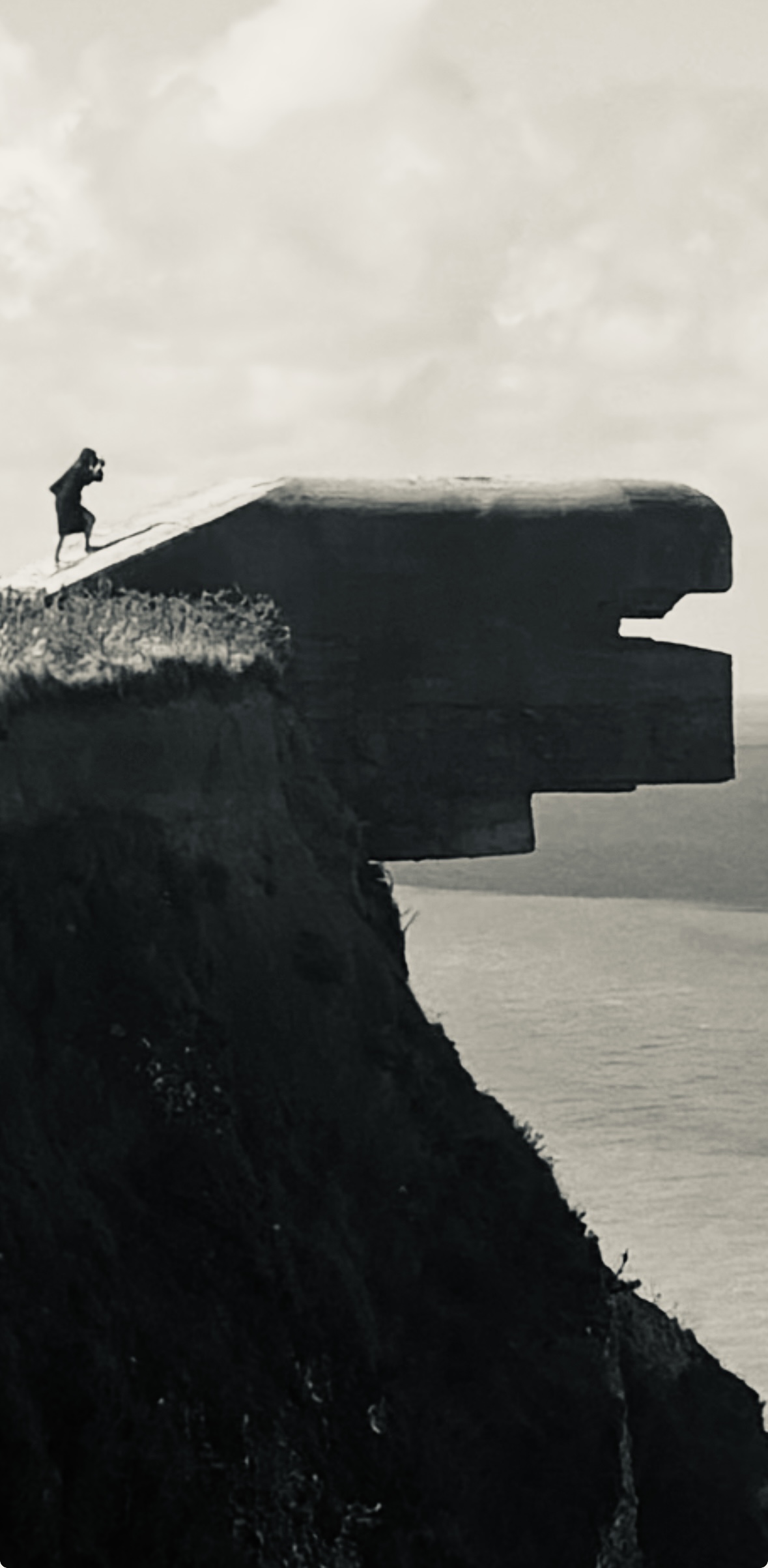
I am currently tracing the sites where several members of my family were forced to work on the construction of the Atlantic Wall during the Second World War.
In early July 1942, both Celina and Markus Wolf received an official summons ordering them to report for compulsory labour with the *Organisation Todt*, the engineering organisation responsible for the construction of the Atlantic Wall. The letter meticulously specified what they were expected to bring: sturdy shoes, two pairs of socks, a warm coat, two shirts, two pairs of trousers, a lunch box, an unbreakable cup and a spoon. They were instructed to report to the *Werbestelle*—the German labour recruitment office for compulsory employment- located within *Feldkommandantur* 681 in Hasselt.
From there, they were transported as forced labourers to one of the construction camps dispersed along the Atlantic coast. This summer I am retracing that same geographical trajectory, following the Atlantic Wall from the Belgian coastline to the beaches of Normandy where the Allied landings would later take place. The journey takes the form of an analogue slide reportage, photographed entirely with a German Voigtländer camera. The resulting images will be presented as a slide projection within a spatial installation conceived as a labyrinth. Visitors navigate through the work while each slide projector produces its characteristic mechanical rhythm—the rattling, clicking and clattering of a technology that, like memory itself, advances frame by frame. The journey concludes at Loos Prison in northern France, where Celina and Markus Wolf were held before their deportation to the Dossin Barracks in Mechelen, one of the principal transit camps in occupied Belgium.
This fieldwork forms part of the research for *Content?*, the book I am currently writing. In order to formulate more precise questions for archives that, much like shrapnel scattered after an explosion, remain dispersed across different countries, I submitted a research request to the archives of the International Committee of the Red Cross in Geneva—fittingly, from my tent yesterday evening while travelling along the Atlantic Wall. During the war, Red Cross delegates visited numerous labour and detention camps, producing reports that today constitute invaluable historical testimony. Unfortunately, these archives are currently inaccessible while undergoing digitisation. According to the archive's schedule, they will become available again in January 2027. Their reopening marks what I anticipate to be the final stage of the research *Content?*. This photograph is the beginning of my research ; photo of my research by Johan Pas.